
Adventure Travel Defined: What Every Explorer Must Know

Adventure travel is defined as any trip that combines at least two of three core elements: physical activity, a natural environment, and cultural interaction. This framework comes from the Adventure Travel Trade Association (ATTA), the industry’s leading authority, and it’s what separates genuine adventure tourism from a standard beach vacation or city break. Whether you’re kayaking through fjords in Norway or trekking with a local guide through rural Vietnam, the ATTA’s 2-of-3 rule is the clearest lens for understanding what adventure travel really means. If you’ve been wondering what is adventure travel defined as, this is your answer.
What is adventure travel defined by at its core?
Adventure travel is built on three foundational elements, and you need at least two of them for a trip to qualify. The Adventure Travel Trade Association established this framework to distinguish adventure tourism from general sightseeing or leisure travel. It’s a practical, flexible definition that covers an enormous range of experiences without demanding that every trip involve extreme risk.
The three elements break down like this:
- Physical activity: This ranges from a gentle guided hike to technical mountain climbing. The activity doesn’t have to be extreme, but it must be active. Sitting on a tour bus doesn’t count.
- Natural environment: The setting matters. Rainforests, mountain ranges, coastlines, deserts, and rivers all qualify. Urban environments alone do not meet this criterion.
- Cultural interaction: This means genuine engagement with local communities, traditions, or ways of life. A staged cultural show at a resort doesn’t cut it. Cooking with a local family in Oaxaca, Mexico, absolutely does.
The beauty of this framework is its flexibility. A wildlife safari in Kenya combines a natural environment with cultural interaction, even if you’re not physically exerting yourself beyond a game drive. A guided whitewater rafting trip on the Colorado River combines physical activity with a natural environment. Both qualify as adventure travel. Adventure travel covers a diverse portfolio of land and water activities, from wildlife observation and sea kayaking to parachuting and mountaineering.
Pro Tip: Before booking any trip, run it through the 2-of-3 checklist. If your itinerary only ticks one box, look for ways to add a second element. Even a short guided community visit can transform a nature tour into a full adventure travel experience.
Soft vs. hard adventure: how does the distinction change things?
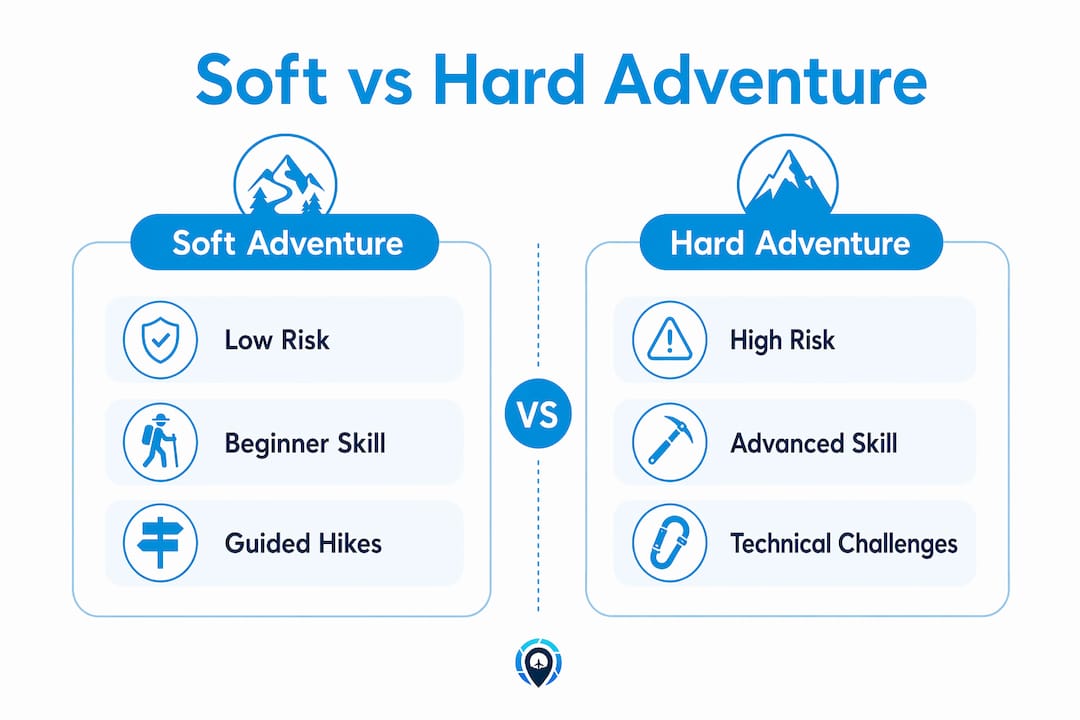
Adventure tourism splits into two broad categories based on risk level and required skill. Understanding where your planned trip falls on this spectrum shapes everything from your gear list to your insurance policy.

Soft adventure describes experiences with lower physical risk and minimal technical skill requirements. These trips are accessible to most healthy adults and often include guided supervision. Think guided Class I and II river floats, beginner-level hiking trails, snorkeling tours, or a camel trek through the Sahara. The risk is managed, the learning curve is gentle, and the focus sits more on the experience than on personal skill development.
Hard adventure sits at the other end. These experiences demand technical expertise, physical conditioning, and a real tolerance for risk. Hard adventures include Class IV whitewater rafting, mountaineering, ice climbing, and multi-day backcountry expeditions. A mistake in these environments carries serious consequences, which is why preparation and professional guidance are non-negotiable.
Here’s a quick comparison to make the distinction concrete:
| Activity | Category | Skill Level | Risk Level |
|---|---|---|---|
| Guided nature hike | Soft | Beginner | Low |
| Snorkeling tour | Soft | Beginner | Low |
| Class II river float | Soft | Beginner | Low |
| Class IV whitewater rafting | Hard | Intermediate | Moderate to High |
| Mountaineering | Hard | Advanced | High |
| Ice climbing | Hard | Advanced | High |
One thing that surprises a lot of travelers: soft adventures still require guided supervision and appropriate safety gear, even when the activity feels casual. Don’t let the “soft” label fool you into skipping preparation. A guided sea kayaking trip in Halong Bay, Vietnam, still demands a life jacket, weather awareness, and a qualified guide.
Pro Tip: If you’re new to adventure travel, start with a soft adventure that genuinely excites you. Build your skills and confidence there before stepping up to harder categories. Rushing into hard adventure without the right preparation is the fastest way to have a bad time.
How are modern definitions of adventure travel expanding?
The traditional definition of adventure travel focused almost entirely on physical challenge and geographic setting. Newer academic and industry thinking is pushing that definition further, and honestly, it makes the concept richer and more useful for trip planning.
Emerging research highlights the relational and reciprocal nature of adventure travel, meaning the relationship between the traveler and the place, the people, and even their own wellbeing. This isn’t just philosophical. It has real practical implications for how you choose and design a trip.
Here’s what this expanded view adds to the definition:
- Traveler wellbeing: Adventure travel increasingly includes mental and emotional restoration, not just physical challenge. A solo trekking trip in Patagonia can be as much about personal clarity as it is about the miles covered.
- Community engagement: More travelers want trips that give back to local communities or support charitable causes. Voluntourism components, locally owned lodges, and community-led tours all reflect this shift.
- Sustainability: Adventure travel evolved from niche extreme activity into a mainstream experiential market that now takes environmental responsibility seriously. Choosing operators who minimize ecological impact is part of the modern adventure travel ethic.
- Cultural depth: Tourists increasingly seek culturally immersive experiences as a core driver of adventure travel, not just a bonus feature. Spending time with indigenous communities in the Amazon or learning traditional crafts in rural Japan qualifies as adventure travel even without a single adrenaline spike.
This broader view explains why about 67% of international travelers say they are “Open to Adventure.” The category now includes low-adrenaline cultural trips alongside high-intensity physical challenges, which means more people can legitimately call themselves adventure travelers.
What should you actually consider when planning adventure travel?
Planning a genuine adventure travel experience means being honest about what you want and what you’re ready for. The ATTA framework gives you a solid starting point, but the practical details matter just as much as the definition.

The average adventure tour costs around $3,000 per person over about eight days, with accommodations ranging from tents to luxury lodges. That price range reflects how broad the category really is. A budget trekking trip in Nepal and a guided luxury safari in Botswana both qualify as adventure travel.
Here are the most common pitfalls to avoid when choosing an adventure experience:
- Falling for “adventure” marketing: Tour operators use the word loosely. Run every trip through the 2-of-3 checklist before booking. A resort with a zip line is not adventure travel.
- Underestimating soft adventure demands: Even low-risk activities require physical readiness and proper gear. Don’t show up to a multi-day hike in trail runners you bought the week before.
- Skipping cultural context: Adventure travel without genuine cultural interaction often feels hollow. Research local customs, learn a few phrases in the local language, and choose community-led experiences where possible.
- Ignoring sustainability: Choosing operators who work with local guides, minimize waste, and contribute to conservation makes your trip better and protects the destinations you love.
- Overloading the itinerary: Packing too many activities leaves no room for the unexpected moments that define the best adventure trips. Build in flexibility.
For destination inspiration across different adventure styles, Travelingportrait’s adventure destinations guide covers everything from whitewater rafting to wildlife observation across multiple continents. And if you’re gearing up for your first hard adventure, the travel gear recommendations on Travelingportrait are worth a look before you start shopping.
Key takeaways
Adventure travel is defined by combining at least two of three elements: physical activity, a natural environment, and cultural interaction, making it distinct from general tourism by its active, immersive, and often reciprocal engagement with place and people.
| Point | Details |
|---|---|
| The 2-of-3 Rule | A trip qualifies as adventure travel when it includes at least two of: physical activity, natural environment, or cultural interaction. |
| Soft vs. Hard Adventure | Soft adventures are low-risk and guided; hard adventures demand technical skill and carry higher physical risk. |
| Evolving Definition | Modern adventure travel includes wellbeing, community engagement, and sustainability alongside physical challenge. |
| Planning Benchmark | The average adventure tour runs about $3,000 per person over eight days, spanning tent camping to luxury lodges. |
| Avoid Marketing Traps | Use the ATTA framework as a checklist to verify a trip is genuine adventure travel before booking. |
Why the 2-of-3 framework changed how i plan every trip
I’ll be honest: before I understood the ATTA’s definition, I used “adventure travel” the way most people do, loosely, to mean anything that felt exciting or slightly uncomfortable. That changed when I started applying the 2-of-3 framework deliberately to every trip I planned.
What I found is that the framework forces you to be specific. It’s not enough to book a trip to a dramatic location and call it adventure. You have to ask: am I actually moving my body? Am I genuinely in a natural setting? Am I connecting with the people who live there? When all three answers are yes, the trip almost always delivers something memorable. When only one answer is yes, it usually feels like a missed opportunity.
The soft versus hard distinction also shifted how I think about preparation. I used to assume that “easy” adventures didn’t need much planning. I was wrong about that more than once. A guided kayaking trip in Southeast Asia taught me that even soft adventures demand respect for conditions, proper gear, and a good guide.
The part of the modern definition that resonates most with me is the relational piece. The trips I remember most vividly aren’t the ones where I pushed my physical limits. They’re the ones where I sat with a local family, ate food I couldn’t name, and felt genuinely welcomed into someone else’s world. That’s adventure travel at its best, and no adrenaline required.
Define your own adventure based on what genuinely excites you, not what looks impressive on social media. The framework gives you the structure. You fill it with meaning.
— Justin
Plan your next adventure with Travelingportrait
Ready to put the definition into practice? Travelingportrait has you covered with destination guides built specifically for adventure travelers who want real experiences, not tourist traps.
Whether you’re drawn to the cultural depth of Asia’s adventure destinations or the dramatic landscapes of Europe , Travelingportrait’s curated guides help you plan trips that genuinely check the adventure travel boxes. You’ll find firsthand accounts, practical gear advice, and destination-specific tips that go well beyond the generic. Start with the full destinations hub and filter by the type of experience you’re after. Your next adventure is closer than you think.
FAQ
What is the official definition of adventure travel?
Adventure travel is defined as any trip that includes at least two of three elements: physical activity, a natural environment, and cultural interaction. This definition comes from the Adventure Travel Trade Association and is the industry standard for distinguishing adventure tourism from general leisure travel.
What is the difference between soft and hard adventure travel?
Soft adventure involves low-risk, guided activities like nature hikes or snorkeling, while hard adventure requires technical skill and carries higher physical risk, such as mountaineering or Class IV whitewater rafting. Both categories qualify as adventure travel under the ATTA framework.
Does adventure travel have to involve extreme sports?
No. Adventure travel does not require extreme sports or high adrenaline. A cultural trekking trip through rural communities or a wildlife safari in a natural setting both qualify as adventure travel when they meet the 2-of-3 element criteria.
How much does adventure travel typically cost?
The average adventure tour costs around $3,000 per person over approximately eight days, though costs vary widely based on destination, activity type, and accommodation style, ranging from budget tent camping to luxury lodge experiences.
How is the definition of adventure travel changing?
Modern definitions now include traveler wellbeing, community engagement, and sustainability as core components alongside physical activity and natural settings. Researchers increasingly describe adventure travel as a reciprocal relationship between the traveler, the environment, and local communities.
Recommended
Other Posts You Might Like