

The Real Role of Travel Itineraries for Better Trips

A travel itinerary is defined as an organized plan that maps your destinations, activities, transport, accommodations, and budget into a single, usable framework. The role of travel itineraries goes far beyond a simple to-do list. Research from Around Travel and NerdBot shows that travelers using personalized itineraries report up to 40% higher satisfaction than those on generic package tours. That’s not a small margin. A well-built itinerary is the difference between a trip that flows and one that drains you before you’ve even hit the halfway point.
What benefits do travel itineraries actually provide?
The benefits of travel itineraries are concrete and measurable, not just theoretical. Here’s what the research actually shows:
- Higher satisfaction. Travelers with structured, personalized plans report 40% higher satisfaction and 50% less travel stress compared to spontaneous or package-tour travelers. That’s a significant payoff for a few hours of planning.
- Better time management. Clustering activities geographically can cut your daily commute times by 30–50%. Less time in transit means more time actually experiencing the place you flew thousands of miles to see.
- Financial control. Itinerary templates that include budget tracking let you monitor and adjust expenses in real time. You catch overspending before it wrecks your last three days.
- Reduced decision fatigue. Custom travel planning filters choices through expertise and context, so you’re not standing on a street corner at 7 p.m. trying to Google “best restaurant near me” while exhausted.
- Safety and documentation. A solid itinerary holds your emergency contacts, booking confirmations, and insurance details in one place. If something goes sideways, you’re not scrambling.
- Psychological anticipation. Neuroscience research from All About Vacation shows that trip planning activates brain reward centers , effectively doubling your total pleasure by making the preparation itself enjoyable. You start enjoying the trip before you even pack.

That last point is one most travelers overlook completely. The planning phase isn’t a chore to get through. It’s part of the experience.
How do you create a travel itinerary that actually works?
Building a useful itinerary follows a clear sequence. Skip steps and you’ll feel it on day two.
- Lock in your logistics first. Book flights and accommodations before you plan anything else. Your hotel location determines which neighborhoods you can realistically reach each day without burning hours in transit.
- Research with the right tools. Use Google Maps to visualize distances, Reddit for honest local tips, and visual platforms like Pinterest or Instagram for inspiration on what’s actually worth seeing. Cross-reference at least two sources before committing to an attraction.
- Group by geographic zone. This is the single most effective time-saving technique. If you’re in Rome, don’t plan the Vatican on the same day as the Colosseum. They’re on opposite sides of the city. Group the Pantheon, Piazza Navona, and Campo de’ Fiori together since they’re all walkable from each other.
- Use the anchor point method. VoyagerNest recommends scheduling 1–2 major activities daily with optional minor ones and built-in buffer time. This prevents the burnout that comes from trying to see everything and actually enjoying nothing.
- Build in a budget section. Assign estimated costs to each day. Include meals, transport, entrance fees, and a small buffer for impulse purchases. Reviewing this each evening keeps you on track.
- Add backup plans. What happens if your first-choice restaurant is closed? What if it rains on your hiking day? Having a Plan B written down means you adapt in minutes, not hours.
- Validate before you leave. Check opening hours, confirm bookings, and verify transport schedules 48 hours before departure. Things change, and catching a closure at home is far less stressful than discovering it on the ground.
Pro Tip: Create a shared Google Doc or use a free tool like Notion to keep your itinerary accessible from any device. Share it with your travel companions so everyone’s on the same page without the constant “wait, what are we doing tomorrow?” conversation.
Rigid vs. flexible: which itinerary style works best?

Not all itineraries are built the same, and the style you choose shapes your entire trip experience. Here’s a direct comparison:
| Style | Pros | Cons | Best For |
|---|---|---|---|
| Rigid, tightly packed | Maximum coverage, no wasted time | High burnout risk, no room for surprises | First-time visitors with limited days |
| Flexible framework with anchor points | Balance of structure and spontaneity | Requires more confident decision-making | Repeat visitors, slow travelers |
| Anti-packed (minimal daily plans) | Deep cultural engagement, low stress | Risk of missing key attractions | Long-stay travelers, digital nomads |
| Generic package tour | Zero planning effort | Low personalization, lower satisfaction | Travelers who want zero responsibility |
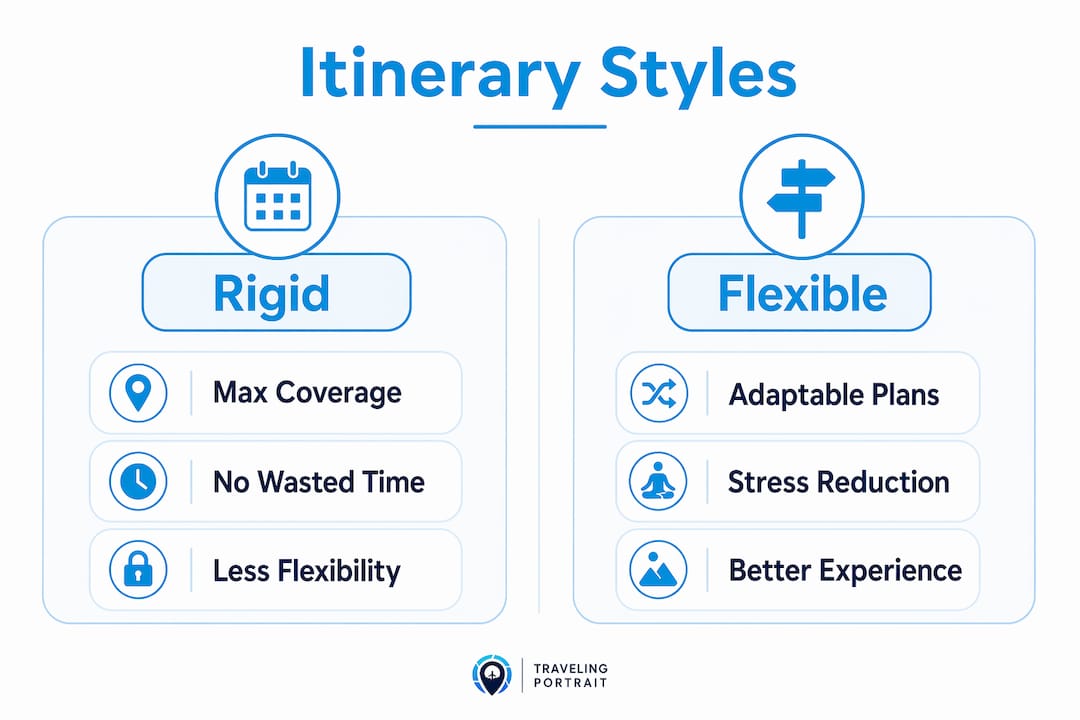
Travel journalist Lauren Harano and coach Sue Ross both advocate for flexible frameworks over rigid schedules. Their reasoning is solid. A tightly packed itinerary treats travel like a checklist. A flexible one treats it like an experience.
The functional sequencing of destinations and accommodations matters just as much as the activities themselves. Booking a hotel on the wrong side of a city because it was cheaper can cost you two hours of transit daily. That’s 14 hours on a week-long trip. Choose your base location based on where you plan to spend most of your time, not just on price.
Pro Tip: If you’re traveling for more than five days, consider splitting your accommodation between two neighborhoods or cities rather than commuting from one fixed base. It cuts transit time and gives you a completely different feel for the destination.
How does personalization strengthen your connection to a trip?
Personalized itineraries do something generic tours simply can’t: they make you an active participant in your own travel story. Here’s why that matters:
- Emotional connection. Active involvement in planning creates a stronger emotional bond with your destination. You chose that specific viewpoint, that specific restaurant, that specific hike. That ownership changes how you experience it.
- Attention and engagement. As Sue Ross puts it, planning is an act of attention that connects you to a place before you even arrive. You learn the history, the neighborhoods, the local rhythms. You show up informed, not just present.
- Reduced mid-trip friction. Custom plans eliminate the constant second-guessing that drains energy. You already decided. Now you just go.
- Pacing that fits you. A 25-year-old backpacker and a 45-year-old traveling with kids need completely different daily rhythms. A personalized itinerary accounts for your actual energy levels, not some average traveler’s.
- Protection of your investment. A poorly located hotel or a missed booking can derail days of a trip. A thoughtful itinerary catches those problems in the planning phase, not after you’ve already paid.
The market is moving this direction fast. The personalized travel experience sector is expected to reach $317 billion by 2029. That growth reflects what travelers are already discovering on their own: generic doesn’t cut it anymore. You can also explore insights on itinerary customization to understand why tailored plans consistently outperform cookie-cutter tours.

Key takeaways
A well-structured, personalized travel itinerary is the single most effective tool for increasing trip satisfaction, cutting wasted time, and reducing travel stress.
| Point | Details |
|---|---|
| Personalization drives satisfaction | Travelers with custom itineraries report up to 40% higher satisfaction than those on generic tours. |
| Geographic clustering saves time | Grouping activities by neighborhood cuts daily transit time by 30–50%, freeing hours for actual experiences. |
| Anchor points prevent burnout | Capping daily plans at 1–2 major activities with buffer time keeps energy and enjoyment high throughout the trip. |
| Flexibility beats rigidity | Frameworks with built-in free time outperform tightly packed schedules for overall traveler satisfaction. |
| Planning is part of the experience | Neuroscience shows that trip preparation activates brain reward centers, adding enjoyment before departure. |
Why i think most travelers are getting itineraries wrong
I used to think a detailed itinerary meant a color-coded spreadsheet with every hour accounted for. I was wrong, and a trip to Japan in 2019 proved it. I had every minute planned. By day three, I was exhausted and resentful of my own schedule. I missed a spontaneous invitation to a local cooking class because I had “temple visit #4” locked in for that afternoon.
The shift I made after that trip changed everything. I started building what I now call a “spine and ribs” itinerary. The spine is your non-negotiables: the one or two things per day that you absolutely want to do. The ribs are flexible options that fill in around them. If you get to them, great. If something better comes up, you let it.
What I’ve found is that this approach works for almost every travel style. The key is knowing your own energy. Some people can handle three major activities in a day and still enjoy dinner. Others hit a wall after two. Your itinerary should reflect your actual self, not some idealized version of a traveler who never gets tired.
I also think people underestimate how much hotel location affects the whole trip. I’ve seen travelers book a beautiful property that’s 40 minutes from everything they want to see. That commute compounds. Pick your base based on your itinerary, not the other way around.
If you’re heading somewhere new, check out Travelingportrait’s destination guides for Europe or North America for real-world itinerary inspiration that goes beyond the typical tourist circuit.
— Justin
Plan your next trip with Travelingportrait
Travelingportrait has spent years building destination guides that go beyond surface-level recommendations. Whether you’re planning a week across Southeast Asia, a road trip through the American Southwest, or a photography-focused tour of European cities, the curated destination guides give you a real starting point for building your own itinerary.
You’ll find region-specific guides for Asia , Europe, and North America, each packed with the kind of detail that actually helps you plan: where to base yourself, what to prioritize, and what to skip. Pair that with the best travel gear recommendations and you’ve got everything you need before you leave home.
FAQ
What is the role of travel itineraries in trip planning?
A travel itinerary organizes your destinations, activities, transport, and budget into a single framework that reduces stress and improves time use. Research shows travelers with structured itineraries report up to 40% higher satisfaction than those without one.
How many activities should i plan per day on a trip?
Cap your daily schedule at 1–2 major anchor activities plus optional minor ones, with buffer time built in. VoyagerNest identifies this as the most effective method for avoiding burnout while still making the most of each day.
What’s the best tool for creating a travel itinerary?
Google Maps, Notion, and Google Docs are reliable free tools for building and sharing itineraries. Google Maps lets you visualize geographic clusters, while Notion or Google Docs keep all your bookings, notes, and backup plans in one shareable place.
Does a flexible itinerary work better than a rigid one?
Yes, for most travelers. Flexible frameworks with anchor points consistently outperform tightly packed schedules for overall satisfaction, according to travel journalist Lauren Harano and coach Sue Ross. Rigid schedules increase burnout risk and leave no room for unexpected discoveries.
How far in advance should i start planning my travel itinerary?
Start building your itinerary as soon as your flights and accommodations are booked. Research from All About Vacation shows that the planning process itself activates brain reward centers, so starting early adds genuine enjoyment to the overall trip experience.
Recommended
Other Posts You Might Like