

What Is a Travel Bucket List and How to Build Yours
A travel bucket list is a personal collection of meaningful travel experiences you want to complete in your lifetime. It’s not a rigid itinerary or a social media flex. It’s a living document that reflects what genuinely excites you about the world. Whether you’re 25 or 65, having a clear list of travel goals changes how you plan, save, and ultimately experience the places you visit. This guide breaks down what a travel bucket list really means, why it works, and exactly how to build one that you’ll actually follow through on.
What is a travel bucket list, really?
A travel bucket list is the informal name for what goal-setting researchers call a “life goals inventory” applied to travel. The term “bucket list” entered mainstream culture after the 2007 film of the same name, but the practice of writing down aspirational travel goals is far older. Road Scholar, the educational travel organization, has tracked a sharp rise in this behavior. Over 180,000 active users are now maintaining travel wish lists on platforms designed for this purpose, up nearly 40% in under a year. That growth signals something real: travelers are treating their dream trips as goals worth tracking, not just daydreams.
The list itself can include anything from trekking the Inca Trail in Peru to spending a week in a ryokan in Kyoto, Japan. It can include a road trip through the American Southwest or watching the Northern Lights from Iceland. The only rule is that the items must matter to you , not to your Instagram feed.
Why does having a bucket list make travel more fulfilling?
The psychology behind bucket lists is well documented. Writing down goals triggers what researchers call the generation effect: people remember and achieve goals far more reliably when they personally design and write them down. That means your list is not just motivational decoration. It’s a cognitive tool.
Beyond memory, anticipation itself delivers real satisfaction. Planning a trip to Patagonia or the Amalfi Coast gives you something to look forward to for months. That sustained excitement has measurable effects on mood and stress levels. AARP Travel Trends consistently identify the top motivations for bucket list travel as time with family and friends, relaxation, and adventure. Those aren’t shallow reasons. They’re the core of what makes travel meaningful at any age.
Here’s what a well-maintained bucket list actually does for you:
- Gives direction to your savings. When you know you want to do an African safari, you save with purpose.
- Reduces decision fatigue. You stop scrolling endlessly for trip ideas because you already have a shortlist.
- Strengthens relationships. Shared bucket list experiences, like a family trip to New Zealand or a couples’ adventure in Costa Rica, create lasting bonds.
- Builds life satisfaction. Completing experiences you genuinely care about feels different from checking off a trending destination.
“The power of a bucket list lies in personal meaning rather than status or typical expectations.” — Jamie Wake Travel
What actually counts as a bucket list experience?
Bucket list experiences are not limited to expensive or extreme adventures. This is the biggest myth worth busting. A bucket list trip doesn’t have to mean a $15,000 safari or a summit attempt on Kilimanjaro. Travel bucket lists focus on personal significance and breaking routine, not on producing Instagrammable content.
Bucket lists should be dynamic , reflecting your evolving values and changing life circumstances. What mattered to you at 30 may look completely different at 50. A 25-year-old might list solo travel through Southeast Asia and a music festival in Europe. A 50-year-old might prioritize a multigenerational family trip to Japan or a slow travel month in Portugal.
Diverse bucket list items worth considering include:
- Attending a local cultural festival, like Diwali celebrations in Varanasi, India
- Taking a solo trip to build confidence and independence
- A family road trip through national parks in the American Southwest
- Learning to cook traditional food in Hội An, Vietnam
- Watching a sunrise from Machu Picchu, Peru
Pro Tip: Don’t edit your list based on what sounds impressive to others. Write down the trip that makes you feel genuinely excited, even if it’s a quiet week in the Scottish Highlands.
How to create a meaningful travel bucket list
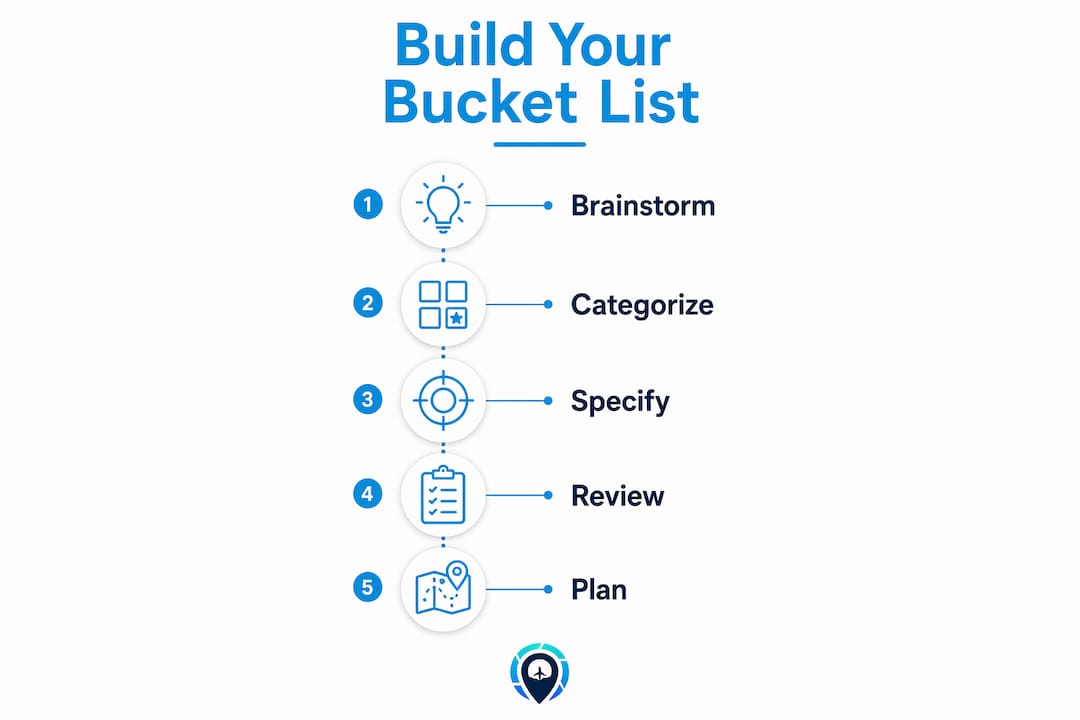
Creating a bucket list that you’ll actually complete starts with one thing: reflection. Grab a notebook or open a blank document and spend 20–30 minutes on a free-form brain dump. This brainstorming session is the foundation of the generation effect. Write without filtering. No idea is too big, too small, or too unrealistic at this stage.
Once you have a raw list, organize it into categories. This makes the list usable rather than overwhelming.
- Destinations. Countries, cities, or regions you want to visit. Examples: Morocco, Kyoto, Patagonia, Iceland.
- Adventures. Activities tied to a place. Examples: scuba diving the Great Barrier Reef, hiking the Appalachian Trail, dog sledding in Norway.
- Cultural experiences. Food, festivals, art, history. Examples: attending Carnival in Rio de Janeiro, visiting the Uffizi Gallery in Florence.
- Personal milestones. Solo travel, traveling with your kids, or a trip with an aging parent.
- Photography goals. If you’re a visual traveler, specific shots or locations worth capturing.
After categorizing, make each item specific. “Visit Asia” is not a bucket list item. “Spend two weeks cycling through rural Vietnam” is. Vague goals, missing deadlines, and poor visibility are the three main reasons bucket list items never happen. Fixing all three can triple your completion rate.
Pro Tip: Set a quarterly review date in your calendar. Every three months, look at your list, update it, and pick one item to actively plan. This single habit separates dreamers from doers.
Here’s a simple framework for structuring each item:
| Element | Example |
|---|---|
| Destination or experience | Trek to Everest Base Camp, Nepal |
| Target timeframe | Within the next 3 years |
| Next concrete action | Research guided trek operators this month |
| Budget estimate | $4,000–$6,000 all-in |
Breaking big goals into 3–5 manageable steps with concrete next actions prevents procrastination. “Research guided trek operators” is a step you can do this weekend. “Go to Nepal someday” is not.
How do you plan and execute bucket list trips effectively?
Planning is where most bucket list trips either come to life or quietly die. The lead time you need depends entirely on the complexity of the trip. Complex trips like African safaris require 18–24 months of planning. Standard bucket list trips, like a two-week tour of Japan or a road trip through Scandinavia, need at least 12 months to book flights, accommodations, and experiences at the right price.
Building a balanced itinerary around your bucket list moment, rather than forcing the entire trip around one event, leads to a far better experience. If your bucket list item is seeing the cherry blossoms in Kyoto, don’t fly 14 hours just for three days. Build a two-week Japan trip that includes Kyoto, Tokyo, and Hiroshima. The cherry blossoms become the highlight, not the entire justification for the trip.
Here’s a comparison of planning approaches:
| Trip type | Recommended lead time | Key planning priority |
|---|---|---|
| African safari | 18–24 months | Operator selection and permits |
| Japan or Southeast Asia | 12 months | Flights and accommodation in peak season |
| European city trip | 6–9 months | Budget flights and accommodation |
| American road trip | 3–6 months | Route planning and national park permits |
| Local or regional trip | 1–3 months | Flexibility and spontaneity |
Priorities shift as life changes, and that’s fine. Defining your intention before booking helps you choose the right trip at the right time. Are you craving adventure right now, or do you need rest? Is this a solo trip or a family experience? Answering those questions before you book saves money and prevents disappointment.
A few practical rules for executing bucket list trips well:
- Book the hardest-to-get element first. Permits for places like Machu Picchu or the Faroe Islands sell out months in advance.
- Plan trips around your travel style , not someone else’s highlight reel.
- Keep your list updated as your priorities evolve. A list that no longer reflects who you are will never get completed.
- Build buffer days into complex trips. Weather, logistics, and jet lag are real.
Key takeaways
A travel bucket list works because it turns vague travel dreams into specific, trackable goals with personal meaning behind them.
| Point | Details |
|---|---|
| Define it personally | A bucket list reflects your values, not trends or others’ expectations. |
| Write it down | The generation effect proves written goals are remembered and achieved more often. |
| Make items specific | Vague goals fail. Add a destination, timeframe, and one concrete next step. |
| Plan with lead time | Complex trips need 18–24 months; standard trips need at least 12 months. |
| Review it quarterly | Regular updates triple completion rates and keep the list relevant as life changes. |
My honest take on bucket lists after years of travel
I’ve kept a travel bucket list for over a decade, and the version I have today looks almost nothing like the one I started with. That’s not failure. That’s the whole point.
When I first made my list, it was full of adrenaline-heavy adventures: skydiving in New Zealand, bungee jumping in Switzerland, summiting something dramatic. Some of those I did. Others fell away as my priorities shifted. What replaced them surprised me. A slow month in Portugal. A photography trip through the American Southwest. A week in Hội An eating my way through the old town. None of those would have made my original list, but they ended up being the most meaningful trips I’ve taken.
The mistake most travelers make is treating their bucket list as a fixed document. They write it once, stick it in a drawer, and feel guilty every time they don’t cross something off. The adventure travel mindset I’ve come to believe in is the opposite: your list should be a living reflection of who you are right now, not who you were when you wrote it.
The planning process itself is genuinely enjoyable if you let it be. Researching a trip to Bhutan or Iceland for six months before you go means you arrive knowing exactly what you want to see. That preparation pays off every single time.
— Justin
What Travelingportrait can help you plan next
Ready to turn your bucket list into real trips? Travelingportrait covers adventure travel destinations across every continent, from the slot canyons of Arizona to the volcanic landscapes of Iceland.

Whether you’re building your first list or refining one you’ve had for years, the destinations guides on Travelingportrait give you the specific, firsthand detail you need to plan with confidence. Browse Asia travel guides and Europe destination content to find your next bucket list trip. Every guide is written from real experience, with photography and practical advice built in.
FAQ
What is a bucket list trip?
A bucket list trip is any travel experience you’ve identified as personally meaningful and want to complete in your lifetime. It can range from a complex international expedition to a regional road trip, depending on your values and goals.
How do I start creating a travel bucket list?
Spend 20–30 minutes writing down every travel experience that excites you without filtering. Then organize your ideas into categories like destinations, adventures, and cultural experiences, and add a timeframe and one concrete next step to each item.
What should be on a travel bucket list?
Your bucket list should include experiences that genuinely matter to you, not just popular or expensive destinations. Examples include solo travel milestones, family trips, cultural festivals, natural wonders, and photography goals.
How far in advance should I plan a bucket list trip?
Complex trips like African safaris require 18–24 months of planning. Standard international bucket list trips need at least 12 months. Shorter regional trips can be planned in 3–6 months.
How often should I update my travel bucket list?
Review your list every quarter. Regular updates keep the list aligned with your current priorities and, according to goal-setting research, can triple your rate of actually completing the experiences on it.
Recommended
Other Posts You Might Like