

Why Travel Diaries Matter: A 2026 Guide
Travel diaries are defined as personal written records that preserve the sensory details, emotions, and observations of a trip in ways that photos and memory alone cannot. Understanding why travel diaries matter goes beyond nostalgia. Research shows 50% of new memories vanish within one hour, and up to 70% disappear within 24 hours without reinforcement. That stat alone should make every traveler reach for a notebook. A well-kept travel journal, whether handwritten in a Moleskine or typed in Day One, becomes the most honest record of who you were in a place and what it did to you.
Why do travel diaries matter for memory preservation?
Memory decay is fast and unforgiving. Without a written record, the smell of a Marrakech spice market or the exact feeling of standing at the rim of the Grand Canyon fades into a blurry impression within days. Writing by hand deepens memory retention and emotional processing compared to digital notes, because the slower, tactile engagement of handwriting forces your brain to encode information more deliberately. That’s a meaningful difference when you’re trying to hold onto a once-in-a-lifetime experience.
Photos capture what a place looks like. A travel journal captures what it felt like to be there. Travelers who keep diaries report being able to re-enter a memory with far more vividness than those who rely on Instagram galleries alone. Reading a journal entry from a rainy afternoon in Kyoto brings back the cold, the tea, and the conversation in a way that a photograph simply can’t.

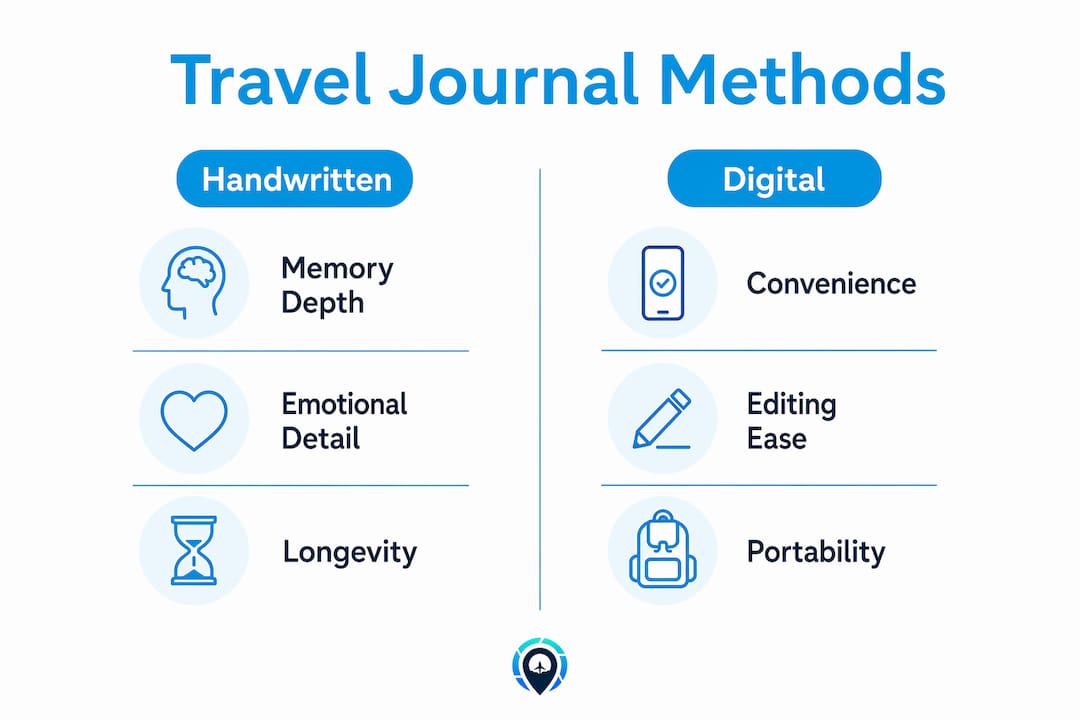
| Method | Memory depth | Emotional detail | Longevity |
|---|---|---|---|
| Handwritten journal | High | Very high | Decades |
| Digital notes app | Medium | Medium | Depends on platform |
| Photos only | Low (visual only) | Low | High but surface-level |
| Social media posts | Low | Very low | Platform-dependent |
Pro Tip: Write your journal entry within two hours of the experience. Memory consolidation happens fast, and the details you capture in that window are far richer than anything you’ll reconstruct the next morning.
The importance of travel diaries also shows up in the long game. Old journal entries reveal changes in confidence, tastes, and worldview that you’d never notice in real time. Reading what you wrote about solo travel in your twenties versus your thirties is genuinely surprising. It’s a record of personal growth that no photo album can replicate.
What emotional and mental health benefits do travel journals offer?
Travel is exhilarating, but it’s also genuinely hard sometimes. Culture shock, loneliness, exhaustion, and disorientation are real parts of the experience. Travel diaries are vital for mental wellbeing, helping travelers process loneliness, culture shock, and fatigue in real time. Writing transforms a chaotic emotional experience into a manageable narrative, which is one of the most underrated benefits of keeping a travel journal.
Journaling works as cognitive offloading. When you write down your anxieties about a missed train or a confusing cultural interaction, your brain releases the mental grip it had on that stress. Travelers report reduced stress knowing their memories and feelings are secured in a journal, which frees them to be more present in the moment. That’s a real shift in how you experience a destination.
Here’s what the emotional benefits actually look like in practice:
- Processing culture shock: Writing about a jarring experience in rural Vietnam or urban Tokyo helps you move from confusion to curiosity faster.
- Managing loneliness: Solo travelers who journal regularly describe feeling less isolated because the act of writing creates a sense of conversation with themselves.
- Building mindfulness: Sitting down to write forces you to slow down and actually notice what happened that day, rather than rushing to the next thing.
- Turning hard moments into stories: A delayed flight or a bad meal becomes a funny anecdote rather than a frustrating memory when you write it down with some distance.
“The journal is a place where you can be completely honest about how travel is making you feel, without performing for anyone.” — Travel writer Taima Ramsey, who emphasizes raw honesty over polished writing in every journal entry.
The role of emotion in travel experiences is something that gets overlooked when we focus only on logistics and highlights. A travel diary gives those emotions a home.
How do travel diaries enhance observation and cultural understanding?
Keeping a travel journal trains you to pay attention differently. Most travelers move through a destination collecting highlights. Journalers move through it collecting details. Travel journaling improves observation skills, enabling travelers to notice nuanced cultural details and sensory experiences they would otherwise walk right past.
Here’s a practical way to think about it. When you know you’re going to write about your afternoon in a Lisbon neighborhood, you start noticing things you’d otherwise ignore:
- The way the tile patterns change from block to block and what that says about the neighborhood’s history.
- The specific hour when locals start filling the cafes and what they order.
- The sounds of the city at different times of day, from morning deliveries to evening conversation spilling out of windows.
- The small rituals people perform, like the way a shopkeeper arranges fruit or a grandmother waters her balcony plants.
- Your own reactions to all of it, which tell you something about your own assumptions and expectations.
None of that ends up in a photo. All of it ends up in a journal. Travel journaling is more than recording. It turns locations into personal stories and transforms a trip from a checklist of sights into a genuine cultural education.
The difference between travel journaling and generic diary writing is specificity. A generic diary entry says “I visited the market today.” A travel journal entry describes the vendor who spoke four languages, the unfamiliar spice you bought without knowing its name, and the moment you realized you’d been standing in the same spot for twenty minutes just watching people. That specificity is what makes the travel journal significant years later.
What are the best methods and tools for keeping a travel diary?
The best travel diary is the one you actually keep. That sounds obvious, but a lot of travelers abandon their journals because they set the bar too high. Selective recording that focuses on personal response rather than logistics enhances enjoyment and preserves meaningful experiences. Rick Steves puts it plainly: focus on how a place felt emotionally, not on documenting every detail.
Handwritten vs. digital journaling
Handwritten journals win on depth. The tactile, slower process of writing by hand produces richer emotional content and stronger memory encoding. A classic Moleskine, Leuchtturm1917, or even a cheap spiral notebook works perfectly. Digital tools like Day One, Notion, or Google Docs offer searchability and the ability to embed photos directly alongside text. Neither is wrong. Many experienced travelers use both: handwritten notes in the field, digital entries at the end of the day with photos attached.
What to actually write about
Skip the logistics. Nobody needs a journal entry that reads like a bus schedule. Instead, focus on:
- Your emotional reaction to a specific moment, not just what happened.
- One conversation that surprised you or changed how you saw something.
- A sensory detail that stuck with you: a smell, a sound, a texture.
- Something you got wrong about the place before you arrived.
Themed journals are another option worth exploring, especially for travelers who want structure. A food-focused journal, a people-focused journal, or a photography companion journal each bring a different kind of attention to a trip.
Pro Tip: Tuck in physical mementos as you go: a bus ticket, a torn corner of a menu, a pressed flower. These small objects trigger memory in ways that words alone can’t, and they make the journal a genuinely physical artifact of the trip.
If you want to go deeper on how your written observations connect to your visual memories, check out Travelingportrait’s guide to travel photography styles. The two practices complement each other beautifully.
Key takeaways
Travel diaries matter because they preserve memories, support mental wellbeing, and deepen cultural understanding in ways that photos and digital records cannot replicate.
| Point | Details |
|---|---|
| Memory fades fast | Write within two hours of an experience to capture the richest detail before decay sets in. |
| Handwriting beats typing | Analog journals produce deeper emotional processing and stronger long-term memory retention. |
| Journaling reduces travel stress | Cognitive offloading through writing frees you to stay present and enjoy the trip more fully. |
| Observation improves with journaling | Knowing you’ll write about a place makes you notice cultural details you’d otherwise miss entirely. |
| Focus on feeling, not logistics | Record emotional responses and sensory details, not schedules, for a journal worth rereading. |
Why I think every traveler should keep a journal, even a messy one
I’ve kept travel journals for years, and the ones I treasure most are the honest, slightly chaotic ones. Not the neat, well-organized entries where I was clearly performing for some imagined future reader. The ones that matter are the pages where I wrote about being genuinely lost in a city, feeling out of my depth at a local ceremony, or sitting alone in a cafe wondering if I’d made a terrible decision booking a solo trip to a country where I didn’t speak a word of the language.
Those entries are uncomfortable to reread sometimes. They’re also the most accurate record of who I was and what travel was actually doing to me. The polished entries tell a story. The raw ones tell the truth.
What I’ve found is that the journal changes the trip itself, not just the memory of it. When you know you’re going to write about your day, you pay attention differently. You ask better questions. You stay in a moment a little longer instead of immediately reaching for your phone. That shift in attention is the real value of travel reflection, and it’s something you can’t get from photos or social media posts.
My honest advice: don’t wait until you have the perfect notebook or the perfect moment. Start with whatever you have. Write badly. Write honestly. The journal doesn’t need to be good. It just needs to be yours.
— Justin
Start your next adventure with Travelingportrait
If reading this has you itching to plan a trip worth writing about, Travelingportrait has you covered. Browse travel destinations across Asia, Europe, and North America for your next journaling adventure. Whether you’re dreaming of Iceland’s open roads or Arizona’s canyon country, there’s a story waiting to be written. And when you’re gearing up for the road, check out Travelingportrait’s travel gear recommendations for the notebooks, pens, and accessories that experienced travelers actually use. The best trip is one you’ll remember forever, and a great journal makes that happen.
FAQ
Why do travel diaries matter more than photos?
Travel diaries capture emotional responses, sensory details, and personal growth that photos cannot record. Research shows 70% of memories are lost within 24 hours without written reinforcement, making journals the most reliable way to preserve a full experience.
How often should I write in a travel journal?
Write daily, ideally within a few hours of the experiences you want to remember. Even a short entry of five to ten sentences captures far more than you’d expect to retain without it.
Is handwriting better than typing for travel journals?
Yes, for memory and emotional depth. Handwriting activates deeper encoding than digital typing because the slower, tactile process forces more deliberate processing of what you experienced.
What should I write about in a travel diary?
Focus on emotional reactions, surprising conversations, and sensory details rather than schedules or logistics. Rick Steves advises writing about how a place felt emotionally, not just what you saw or did.
Can travel journaling actually reduce stress while traveling?
Yes. Journaling reduces anxiety through cognitive offloading, which means writing down worries and experiences frees your mind to stay present and enjoy the trip rather than mentally replaying stressful moments.
Recommended
Other Posts You Might Like